View All


 View All


 View All

 View All

 View All

 View All
 View All
 View All


 View All



“One good thing is that there is really zero pressure. I feel very stressed when I compare my kids and my friends’ kids in Singapore.”
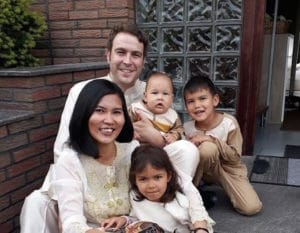
Singaporean Pan Wang Yu and her German husband, Claus, live in Stuttgart, Germany, with their two children (4 and 5), who were both born there. Wang Yu is considering moving back to Singapore for various reasons and has found it challenging to be accepted into the community despite speaking German fluently. While she enjoys aspects of life abroad (the comparative lack of pressure and academic stress), she worries about the political climate and racism. Plus, Wang Yu thinks her kids might be missing out on the academic rigour that Singapore offers, saying, “ I believe that if one can survive and thrive in the Singapore education system, one can face anything in the world.”
Read more Overseas Family stories here.
Disclaimer: All opinions expressed in this article is of the interviewee, and not of Sassy Mama.
When did you move to Germany, and what were the reasons you decided to move there?
We moved to Stuttgart in 2019, just before COVID happened. My husband wanted to return home as his parents were elderly. He had been homesick for quite a long time, as he had stayed in Singapore mainly for our relationship.

Why are you considering moving back to Singapore now?
My mum contracted cancer earlier this year. When I received the news, it came as a huge shock. The helpless feeling of not being able to drop everything and be by her side lest anything happen was rather painful.
After living in Germany for 6 years, I would say that I have given Germany a good shot. My degree isn’t recognised here so the jobs that I can do are all low-paying. In terms of politics, the rise of far right sentiment means I don’t feel safe, and I don’t want my kids to face racial discrimination. I also do not feel welcome here and am often excluded when speaking in a group, even though I speak German at an advanced level. After many years of trying to find my own tribe, I am tired.
I find the education system lacking here. I prefer my children to be resilient and have rigour when it comes to studying. I believe that if one can survive and thrive in the Singapore education system, one can face anything in the world. My kids do the homework I set every weekend. I print out worksheets in English and Mandarin, and they do assessment books from Singapore. They decide how many pages they want to complete. To be honest, I am undecided about moving back home as I think that my children are less motivated than their peers in Singapore. Plus, my husband would have to work longer hours.
Favourite aspect about living in Germany?
It is less stressful here. Perhaps it’s because I don’t work full-time! People here are generally happier and therefore nicer because they are less stressed. They smile more. They don’t seem to have as many worries. There is also a lot less pressure to earn more (work harder/ do something you dislike), as you know that there is always a safety net.
And the worst part?
Germany’s inefficiency. One example is my process for applying for PR in Germany. It was supposed to be a 6-month wait, but it became a 3-year wait. During which my visa expired, and I had to get temporary visas three times.
How did you meet your partner?
We met in Singapore. During our first date, we established that we were both looking for a serious relationship.
Did you give birth in Germany, and if so, did anything stand out about the experience?
I gave birth in Germany twice. I found it interesting that the majority of the mothers in Singapore kept talking about epidurals and thinking that there was no way they could give birth without one (if it were a natural birth). My husband said I didn’t even ask for an epidural. I also chose a water birth for both. I’m not sure if that is an option in Singapore.
Another stark difference was that in Stuttgart, you cannot really choose where to give birth. If the hospital is full, you have to look for another hospital. I was in labour, and 6cm dilated for my first birth when I arrived at the hospital. A nurse admitted me, but later someone told me I had to leave as they were full. They said that, being my first birth, the whole process would take a very long time, so I had time to go look for another hospital. I couldn’t even walk then! Luckily, after some discussion and persuasion, another mom who was not dilated was told to leave (sorry!). I gave birth soon after.
A midwife came to check on my baby once every few days after I was discharged for 2 weeks. This was paid for by my health insurance. Though it is very difficult to find one, some people have to go without any help at all. She would weigh the baby and teach us how to bathe it, too.
My parents came to help me do my confinement both times. I wish I could have gotten the jamu massages after birth.
How do you think parenting (and schools) in Germany differ from Singapore? What do you appreciate most about it?
Parents here really believe in gentle parenting. When kids misbehave, they are just told not to do whatever bad action again. In Singapore, there are consequences for kids who misbehave. My kids are considered extremely well-behaved in Germany but wild in Singapore. Last year, I walked past a kindergarten class on an excursion in Singapore, and the kids were standing in two straight rows, waiting for instructions! You’ll never see that in Germany.
Parents in Germany don’t worry too much about academics. Tuition is generally for kids who are struggling. Prices for all classes are much lower than in Singapore. For example, I am paying 160 euros per year for a weekly sports class for one child.
Another stark contrast is that the kindergartens here close unexpectedly frequently. For instance, if there’s a strike or a member of staff is sick.
The kindergarten my kids attend lets them go out to play in the garden for at least an hour every day, unless there’s a storm, which I appreciate. Children learn skills through play. Math, German, etc., are not taught. Children are not potty-trained at kindergarten, either – it’s all up to the parents.
The primary schools here are very small. Most schools I know of have only 2 or 3 classes per level. So everyone knows everyone. I was surprised to see school kids hugging and jumping on the principal.
There is after-school care in primary schools, though not everyone is guaranteed a spot. If you are unlucky and don’t get a spot, it usually means a parent can work part-time. Some schools are half-day schools, some are full-day schools. The end times differ from school to school. The ones I know end at 12:30pm and 4pm. There is an hour of homework, and the kids in after-school care just play outdoors for the rest of the time.
I found it interesting that you can decide to let your child start school one year earlier (if your child is born before a certain cutoff date) or one year later if your child is not ready for school behaviourally. Germans do not see starting school later as a bad thing.
One good thing about living in Germany is that there is really zero pressure. If I were living in Singapore, I know my kids would be attending drama, dance, art, music and swimming classes. I know I shouldn’t compare, but I feel very stressed when I compare my kids and my friends’ kids in Singapore.
What do you find is the hardest part of being a parent living in a foreign country?
You have to do everything yourself. A babysitter is expensive (about 20 euros an hour). A cleaner is also expensive (about 20 euros an hour). You cannot just walk out and Dabao food as restaurants are also expensive (about 20-26 euros for a main), and not many grocery shops (or restaurants) do deliveries, so you literally do everything yourself.
Many women do not work full-time due to the short school hours.
Have you managed to integrate with the local community?
I am about half integrated. I would integrate much better if I had a full-time job. I speak German at a C1 level (so fluent).
Tell us about your career pre- and post-kids
I was a civil servant in Singapore. Now I work 100%, 24/7 as a mother (with neither sick nor annual leave).
How do you and your partner juggle work and dividing up family roles?
The majority of the housework falls on me. I am expected to be there for the kids. My husband cooks on the weekend, although I sometimes help. My husband does the gardening and DIY jobs. We take turns putting the kids to bed. I take the kids to most of their appointments, except for Mandarin class, which my partner takes them to.
Is there something that you do to keep your children in touch with their Singaporean roots?
When National Day is nearing, I play NDP songs. Likewise for Chinese New Year. I tell the kids stories about Chinese festivals, e.g., the Mid-Autumn Festival. We go back to Singapore once a year and call my family almost every week. I try to hang out with Singaporeans and Chinese so that they get a chance to speak Singlish/ Mandarin. We also hang out with other families who speak English, so they have a chance to speak the language. I hang the Singaporean flag in my home for my kids to know what our flag looks like, and we sometimes eat Singaporean food like bak zhang.
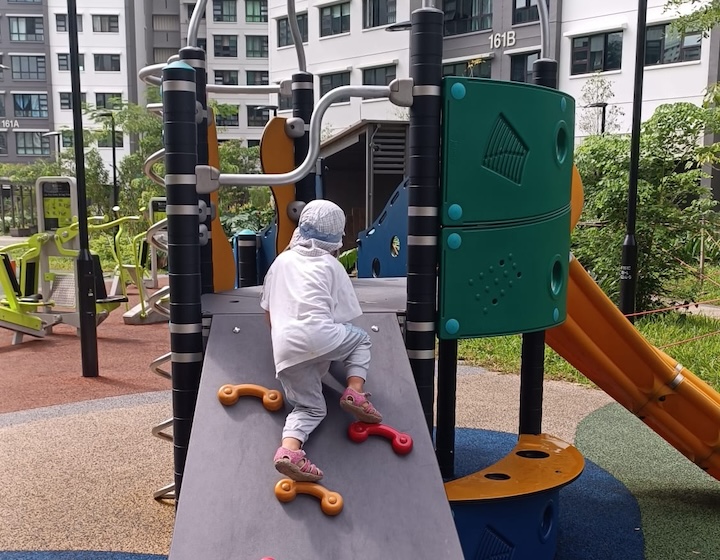
On raising a multilingual child …
I speak exclusively Mandarin to the kids, my husband speaks English to them and the paternal grandparents talk to them in German. German is the community language so it’s the language that the kids are best at. They also speak a little Spanish because they attend a bilingual kindergarten.
When my kids reply to me in German, I tell them I don’t understand so they will have to speak to me in Mandarin. My daughter tells me I should learn German, haha.
What is the first thing you do each time you come back to Singapore?
We look out for my parents who pick us up from the airport (very thankful for that), then shower, then sleep. I usually have porridge/ wanton mee/ meefen mian for breakfast the next day. Unfortunately, there’s no good Hokkien mee near my parents’ place. When I am sure I am healthy, I visit my grandparents. I don’t want to spread anything to them as they are old and precious to me.
What do you always bring back from Singapore for yourself and for your child?
I bring assessment books and storybooks back for my kids. For myself, Milo and Maggie Mee. I still bring half my life’s worth of things back from my parents’ place every trip.
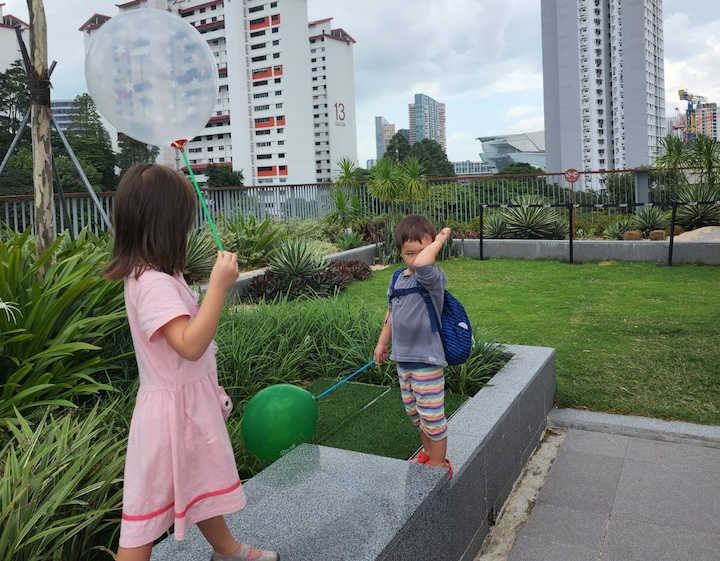
Top five places in Stuttgart or Germany that you would recommend to parents travelling with kids, and why.
- Schlossplatz, Stuttgart – the centre of Stuttgart (think Orchard Road). It is glorious when it’s a sunny day – many will lay on the grass and bask in the sun.
- I like Munich for its posh vibe and the Isar. Being there makes me very happy.
- Mercedes Museum. Interesting to visit the world’s first automaker. They have lots of beautiful cars on display – you can easily spend a whole day there.
- Christmas markets. Each market is different, so I would suggest spending time visiting each city/ town’s market. The one in Stuttgart has a train that kids (and adults) can sit on. The one in. Berlin has a live Santa Claus ziplining down.
- Wasen in Stuttgart in May and September. It’s the second biggest Oktoberfest-like event in Germany. Go there in the day with kids for the pasar malam rides.
What’s the one thing you would miss about Germany if you moved away?
The lack of stress. I would also miss the universal healthcare.
What do you dread and look forward to most if you were to move back to Singapore?
I’m not looking forward to the stress which comes with living in Singapore. I will worry about money regardless of how much money I have. The competition and constant rat race.
I look forward to being with my family and friends! I welcome the sun and humidity with open arms, the cheap, good food and shops being open every day. I look forward to visiting libraries with my kids.
How do you think Singaporeans can benefit from living overseas?
Living overseas opens one’s eyes. It challenges your perception of truth and broadens your horizons. It pushes you out of your comfort zone so you can learn to spread your wings. You will also become more appreciative of your life back in Singapore. Learning the language of the country you live in will help tremendously. Also, go in with an open and humble heart. Do not make the mistake of expecting things to work/be efficient.
Read more: